
Miria by Atempo is a scalable, high-performance data management platform designed to handle large volumes of unstructured data across heterogeneous environments. Its architecture is modular and built for flexibility, enabling seamless integration with various storage types, including NAS (NFS/SMB), object storage (S3-compatible), parallel file systems, and tape libraries.
At the core of the architecture is the Miria Server, which acts as the central management engine, responsible for orchestrating data movement, managing policies, job scheduling, monitoring, and logging. Miria Agents are lightweight components deployed close to the data sources and targets, performing read/write operations and processing tasks locally to optimize performance and reduce network load.
The platform supports parallel data processing and can scale horizontally by deploying multiple agents to meet high throughput demands. A user-friendly Web UI and REST API allow for easy management, automation, and integration with third-party systems. Miria also includes advanced features such as replication with failover, deduplication, bidirectional synchronization, and detailed audit logging, making it ideal for use cases like backup, archiving, migration, and long-term data retention in enterprise environments.
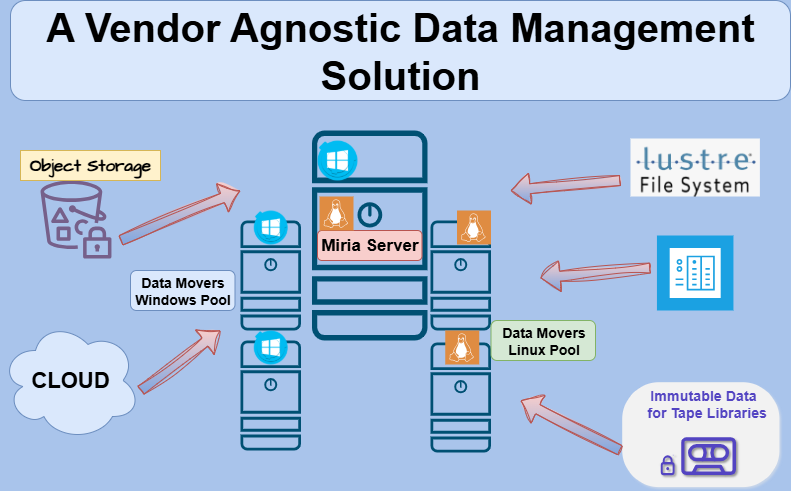
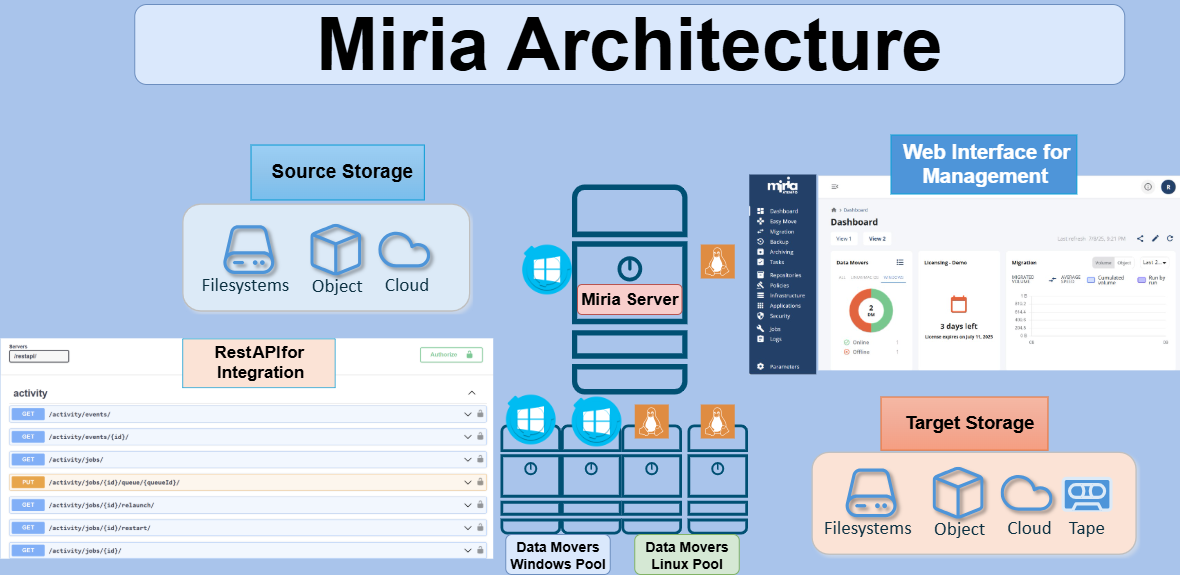
Atempo Miria is designed with a flexible, modular architecture tailored for managing petabyte-scale unstructured data across complex IT environments. The platform supports a wide range of data workflows including backup, archiving, synchronization, and migration across heterogeneous storage systems such as NAS (NFS/SMB), parallel file systems (Lustre, GPFS), object storage (S3-compatible), and tape libraries (LTFS).
At the heart of the architecture is the Miria Server, which handles policy management, job scheduling, monitoring, and orchestration. It works in conjunction with distributed Miria Agents deployed near the data sources and destinations. These agents locally handle data read/write operations, deduplication, and transfer acceleration, thereby optimizing bandwidth usage and enhancing performance.
Miria's architecture supports parallel and scalable processing, allowing multiple agents to run simultaneously and handle billions of files efficiently. The system also offers a user-friendly web interface and a robust REST API for policy configuration, job control, and integration with external platforms.
Key architectural capabilities like bidirectional replication, failover and resynchronization, and deduplication ensure data integrity, high availability, and cost-efficient storage utilization. This robust architecture makes Miria ideally suited for enterprise environments with demanding data protection, mobility, and compliance requirements.
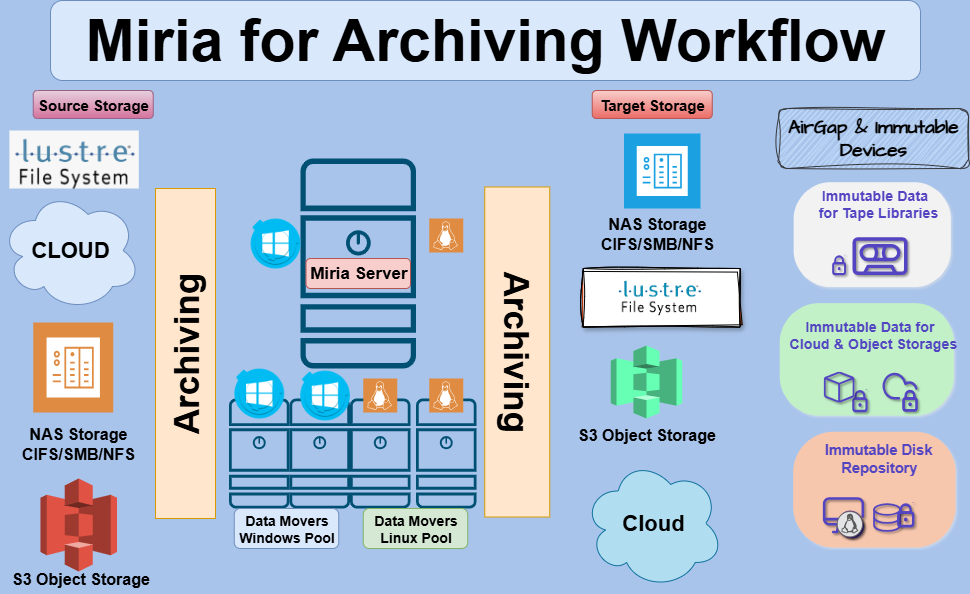
Atempo Miria for Archival is a robust, enterprise-grade solution designed to manage the long-term retention of unstructured data across heterogeneous environments. It enables organizations to offload rarely accessed but critical data from high-cost primary storage to more cost-effective secondary or archival tiers—such as object storage, NAS, or tape—without compromising accessibility or data integrity. Miria’s policy-driven architecture allows IT teams to define flexible archival rules based on metadata attributes like file age, type, size, or location.
Once archived, the data can be accessed directly (if desired) or restored back to primary storage on demand. The solution supports deep integration with existing file systems and can handle billions of files and petabytes of data while maintaining full metadata fidelity.
With features like multi-tier archiving, indexing, audit logging, and encryption, Miria ensures data is stored securely and remains searchable and compliant with long-term retention and regulatory requirements. Whether for cost optimization, compliance, or digital preservation, Miria for Archival offers a reliable, scalable, and vendor-agnostic approach to managing inactive data.
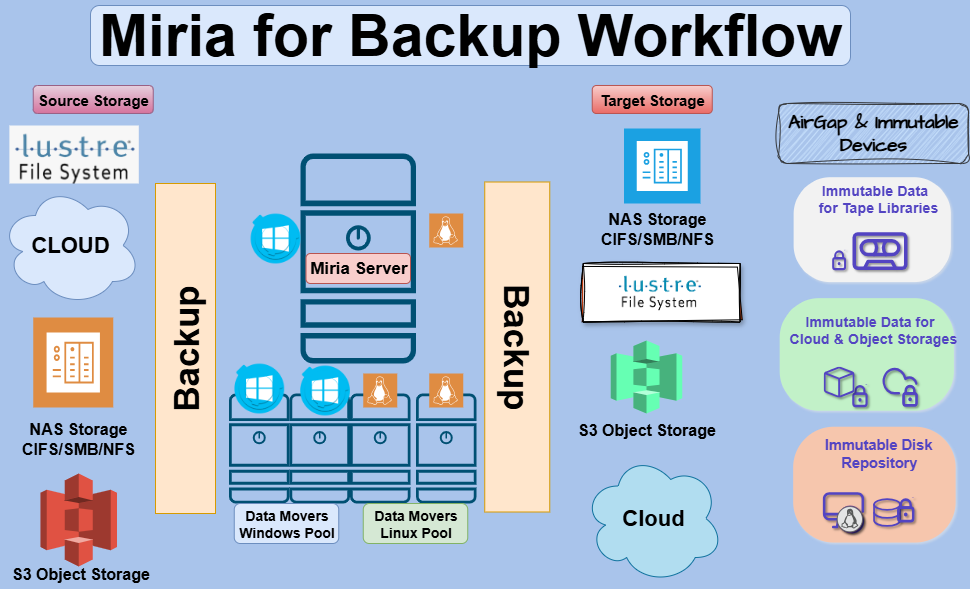
Atempo Miria for Backup is a powerful and scalable solution designed to protect large volumes of unstructured data across complex, multi-platform environments. It enables high-performance, policy-based backups from heterogeneous storage systems—including NAS, parallel file systems (e.g., Lustre, GPFS), and object storage—to secure destinations such as tape libraries, cloud, or secondary storage.
Miria’s distributed agent-based architecture ensures efficient data processing close to the source, allowing backups of billions of files and petabytes of data with minimal impact on production environments. The solution supports full, incremental, and differential backups, and features like deduplication, replication, and failover enhance data protection, reduce storage costs, and improve availability.
With centralized management via a web-based UI and REST API, organizations can automate backup policies, monitor job status, and maintain audit-ready logs. Miria for Backup is ideal for enterprise and HPC environments that demand reliable, scalable, and vendor-independent protection for critical unstructured data.
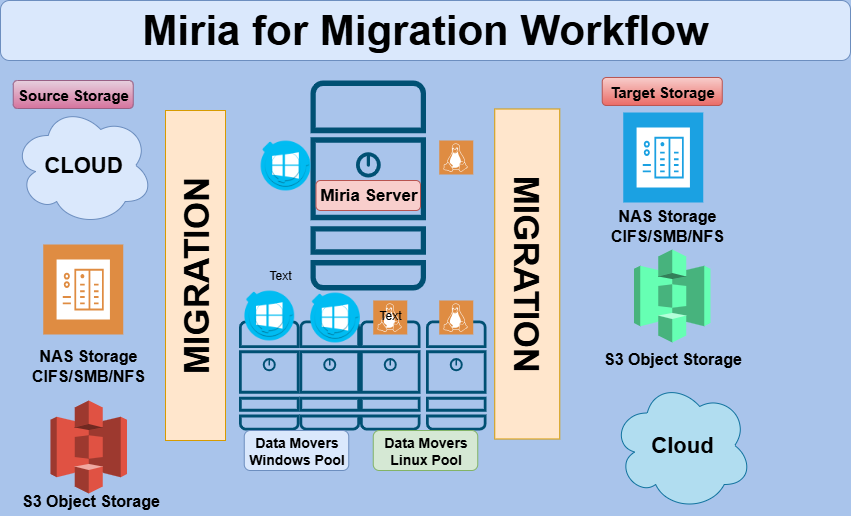
Atempo Miria for Backup is a powerful and scalable solution designed to protect large volumes of unstructured data across complex, multi-platform environments. It enables high-performance, policy-based backups from heterogeneous storage systems—including NAS, parallel file systems (e.g., Lustre, GPFS), and object storage—to secure destinations such as tape libraries, cloud, or secondary storage.
Miria’s distributed agent-based architecture ensures efficient data processing close to the source, allowing backups of billions of files and petabytes of data with minimal impact on production environments. The solution supports full, incremental, and differential backups, and features like deduplication, replication, and failover enhance data protection, reduce storage costs, and improve availability.
With centralized management via a web-based UI and REST API, organizations can automate backup policies, monitor job status, and maintain audit-ready logs. Miria for Backup is ideal for enterprise and HPC environments that demand reliable, scalable, and vendor-independent protection for critical unstructured data.
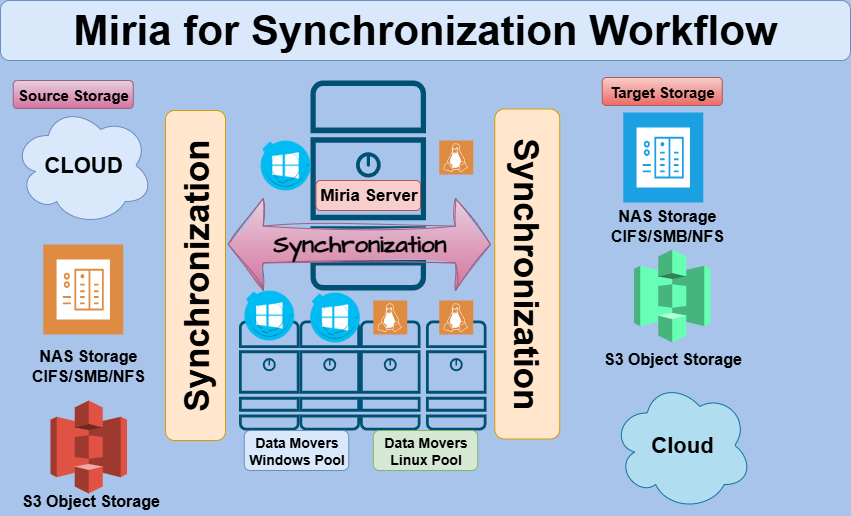
Atempo Miria for Sync is a powerful solution designed to enable continuous or scheduled synchronization of large-scale unstructured data between heterogeneous storage systems. Built for enterprise and high-performance environments, Miria for Sync ensures that data residing on NAS, parallel file systems, or object storage is consistently mirrored across multiple locations—whether for disaster recovery, collaboration, or hybrid cloud scenarios.
The solution supports bidirectional and unidirectional synchronization, offering flexibility to match various business use cases. Miria’s agent-based architecture allows high-speed, distributed data movement, preserving metadata and file integrity while minimizing network impact.
With advanced features like resume-on-failure, change detection, and real-time monitoring, Miria ensures that your data stays up-to-date, synchronized, and protected—no matter where it's stored. Its non-intrusive design and policy-based control make it ideal for use in environments requiring high availability, business continuity, or global data distribution.